How
can arguing and giving up any "right" to our own opinion save our
lives, improve our country, and secure the future for the next
generation?
Friday, September 4, 2020
essay prompt for the weekend
Here is the question you'll be writing on. Email with any questions. Due on your blog by Monday at 5:00 P.M.

september 4
JOURNAL TOPIC: [today's tunes: "Smile Away" by Paul McCartney; "The Shadow of Your Smile" by Marvin Gaye]
Where do smiles come from? What makes you smile? A recent study suggests that just the simple, physical act of moving your face into a smile can make you feel better -- try it. (Did it work? :)
-OR-
Choose your own topic.
AGENDA:
1. Journal
2. Finish your essay (it's due by 5:00!)
3. Ask someone to interview you for Hack to School Night (the video post still isn't up - I apologize - but it will be by tonight)
Where do smiles come from? What makes you smile? A recent study suggests that just the simple, physical act of moving your face into a smile can make you feel better -- try it. (Did it work? :)
-OR-
Choose your own topic.
AGENDA:
1. Journal
2. Finish your essay (it's due by 5:00!)
3. Ask someone to interview you for Hack to School Night (the video post still isn't up - I apologize - but it will be by tonight)
Thursday, September 3, 2020
september 3
JOURNAL TOPIC: [today's tunes: "Lo Que Dice" by Ozomatli; "Words (Between the Lines of Age)" by Neil Young]
Adults say it to toddlers all the time: "Use your words." What do you mean, my words? We know that fiction authors use dialogue for the purpose of indirect characterization-- as you write the story of your life each day, how do the words you choose create an impression of who you are?
-OR-
Choose your own topic.
AGENDA:
1. Journal
2. Hack to School Night (due Tuesday)
3. Essay (due Friday)
Adults say it to toddlers all the time: "Use your words." What do you mean, my words? We know that fiction authors use dialogue for the purpose of indirect characterization-- as you write the story of your life each day, how do the words you choose create an impression of who you are?
-OR-
Choose your own topic.
AGENDA:
1. Journal
2. Hack to School Night (due Tuesday)
3. Essay (due Friday)
Wednesday, September 2, 2020
september 2
JOURNAL TOPIC:
Describe a time when someone said something so unexpectedly funny that it caused you or someone nearby to spit out a mouthful of food or drink (bonus points if anything came out a nose). If you haven't seen this happen, describe something you think is funny enough to make it happen.
-OR-
Choose your own topic.
REMINDERS:
1. Your "Hack to School" answers should be posted by the end of today (Wednesday, 9/2)
2. Ideas and tips for capturing your interview on video and posting on your blog will be posted here by Thursday (9/3) 10:00 AM
3. Instructions for posting your essay will also be posted here by Thursday (9/3) 10:00 A.M.
4. Your essay is due on your blog by 5:00 P.M. on Friday (9/4)
AGENDA: (for September 1 & 2)
1. Journal
2. Review and discuss post: do. or do not. there is no essay
3. Review and discuss Basic Essay Structure
3. Discuss Hack to School Night questions
DO:
1. Comment to the post: do. or do not. there is no essay
2. Create an outline for your essay and begin a first draft in response to this prompt:
Describe a time when someone said something so unexpectedly funny that it caused you or someone nearby to spit out a mouthful of food or drink (bonus points if anything came out a nose). If you haven't seen this happen, describe something you think is funny enough to make it happen.
-OR-
Choose your own topic.
REMINDERS:
1. Your "Hack to School" answers should be posted by the end of today (Wednesday, 9/2)
2. Ideas and tips for capturing your interview on video and posting on your blog will be posted here by Thursday (9/3) 10:00 AM
3. Instructions for posting your essay will also be posted here by Thursday (9/3) 10:00 A.M.
4. Your essay is due on your blog by 5:00 P.M. on Friday (9/4)
AGENDA: (for September 1 & 2)
1. Journal
2. Review and discuss post: do. or do not. there is no essay
3. Review and discuss Basic Essay Structure
3. Discuss Hack to School Night questions
DO:
1. Comment to the post: do. or do not. there is no essay
2. Create an outline for your essay and begin a first draft in response to this prompt:
How can arguing and giving up any "right" to our own opinion save
our lives, improve our country, and secure the future for the next
generation?
3. Post your answers to Hack to School Night questions on your blog
(title: I HAVE THE ANSWERS/ first sentence: "I know exactly what to tell
my support team about my learning.")
Tuesday, September 1, 2020
september 1
JOURNAL TOPIC: [today's tunes: radio silence]
What song do you sing when there's nothing on the radio? What thoughts do you think when it's quiet and you have the chance to think about whatever you want?
-OR-
Choose your own topic.
AGENDA: (for September 1 & 2)
1. Journal
2. Review and discuss post: do. or do not. there is no essay
3. Review and discuss Basic Essay Structure
3. Discuss Hack to School Night questions
DO:
1. Comment to the post: do. or do not. there is no essay
2. Create an outline for your essay and begin a first draft in response to this prompt:
What song do you sing when there's nothing on the radio? What thoughts do you think when it's quiet and you have the chance to think about whatever you want?
-OR-
Choose your own topic.
AGENDA: (for September 1 & 2)
1. Journal
2. Review and discuss post: do. or do not. there is no essay
3. Review and discuss Basic Essay Structure
3. Discuss Hack to School Night questions
DO:
1. Comment to the post: do. or do not. there is no essay
2. Create an outline for your essay and begin a first draft in response to this prompt:
How can arguing and giving up any "right" to our own opinion save our lives, improve our country, and secure the future for the next generation?
3. Post your answers to Hack to School Night questions on your blog (title: I HAVE THE ANSWERS/ first sentence: "I know exactly what to tell my support team about my learning.")
do. or do not. there is no essay
Last year I asked 150 high school juniors in four separate classes to
think of a word they associate with writing essays. After giving them a
couple minutes to think, I stood at the board and wrote down the words
they called out. Here are the lists:
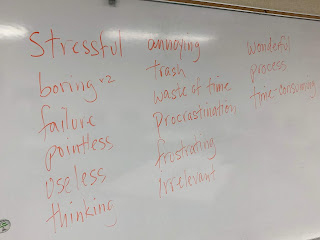


As you can see, the students' feelings about writing essays were overwhelmingly negative. I was struck by the patterns, which were amazingly consistent, considering the 36+ different personalities in four different classes. "Stress" is on every list. "Anger," "crying," and "dropout" showed up multiple times. I tried to imagine what writing must be like for the student who contributed "shaking." Shaking? When I showed one of the lists to another teacher, he said, "What's wrong with those students?"
It was a loaded question and it got my attention. There was definitely a problem here, but why assume that the defect was within the students? Was this a function of stereotyping teenagers as lazy complainers? Was it a lack of empathy from a teacher who rushed to defend a system that rewarded him with a diploma and a jobs?
In our culture, whoever names a problem risks being identified as the problem. Too often we blame the victim. An employee who points out a legitimate issue at work may be targeted for having a "bad attitude." Think of the last time a student's (phone, backpack, wallet) was stolen. Stealing is bad, and wrong, and it should never happen. But when people hear about something like this, someone often says something like, "Dude, he shoulda been more careful with his stuff."
Even victims of rape and violence are forced to endure ridiculous questions, and sometimes even direct accusations, as if they had anything at all to do with the horrible thing that was done to them. No wonder people are so often reluctant to come forward.
This is why my first response to the students was gratitude. I thanked them. I wanted to acknowledge the trust and courage it took for them to speak up. No one likes to admit that something is this awful, especially when they've been told repeatedly to get over themselves because it shouldn't be a big deal and everyone else can do it and they should too.
My second response was to ask the students if, when they thought of the word "essay," they were describing an experience that involved:
The expressions on their faces in those moments were so open. Their eyes were wide. There was energy in the room. Suddenly you couldn't help but realize that is so much more to these young people than they usually show in class. You could tell they were surprised to hear their lived experience described so plainly and accurately by a teacher. One student even said, "Thank you for offering us some understanding."
As I watched them begin to take notes, I started thinking about the Hawthorne Effect. The Hawthorne Works was a big factory in Illinois where thousands of workers made telephone equipment and consumer products. In the 1920s, the company commissioned a study to learn about productivity.
During the study at The Hawthorne Works, every single change, like making the lights brighter or making the lights dimmer, seemed to increase employee productivity. What kind of sense does that make? If you make the lights brighter, and productivity goes up, how can dimming the lights also make productivity go up?
The real insight wasn't that productivity increased because of the actual changes that management made; it was that when management was sympathetic, willing to listen, and keep their promises, the employees put in more effort.
This is an excellent place to start in the classroom.
Getting any kind of honest feedback depends on trust, and trust is earned. At this point in our culture, trust also has to be modeled, because many young people simply haven't seen a working example in practice. I demonstrated trust on the first day of school. I told students that they should decide how the course would run, and then I walked out of the classroom and closed the door behind me so they could talk freely.
Ever since that day students have seen me repeatedly honor my word. They have watched me make mistakes -- and openly admit to each one. Students now know that I make good on my offers to help them, which I mention approximately every 3 minutes 41 seconds.
These are some of the reasons why students trusted me when I asked an open-ended question about a touchy subject. After I recorded the first few contributions without judgement, they began contributing more openly and enthusiastically.
That is no small thing. Especially for teachers, because the students we ask to trust us are often experiencing multiple levels of trauma of their own.
According to studies published by the American Psychological Association, anxiety in our culture has increased so much in recent decades that "typical schoolchildren during the 1980's reported more anxiety than child psychiatric patients did during the 1950's." One of the studies' authors said the trend is likely to continue, and she linked anxiety to depression: "The results of the study suggest that cases of depression will continue to increase in the coming decades, as anxiety tends to predispose people to depression."
Students' lives, experiences, and feelings are complicated and intense. Last year, I focused on the fact that our bizarro culture has created an environment that includes mass shootings and active shooter drills at school. This year, we have the pandemic, the economy, politics and (lack of) social justice, and apparently the environment isn't done trying to get our attention, so here come more extreme weather patterns: heat, cold, hurricanes, fires.
Meanwhile, students continue to navigate a challenging maze of opportunity (which they have to find) and danger (which sometimes finds them). This is a game even the winners don't like playing. And the prize? Graduation, followed by toxic student loans.
And still the students show up. There they were last year, courageously expressing their feelings about writing essays. Here they are this year, all over my email and Zoom accounts.
That's heroic. It occurred to me that my new heroes might like to meet an old hero, and someone else who tackled the hardest part of writing, so I introduced them to Montaigne.
Michel Eyquem de Montaigne lived in France from 1533 to 1592. He worked as a government official and he was also a winegrower. Most importantly for us, Montaigne invented a brand new style of writing.
Instead of writing about his personal achievements or historical events, Montaigne wanted to express exactly what he thought and felt. Readers over the years have commented that reading Montaigne's writing is like seeing their own thoughts and feelings in a mirror-- they feel amazed that someone else seems to share inner experiences that they thought were unique to them and unknown to anyone else. In this way, Montaigne created a connection between writer and reader that never existed before.
Montaigne wanted to create value based on a shared understanding, a bond between the writer's inner world and the reader's inner world. This isn't easy. Montaigne himself called it a "thorny undertaking, and more so than it seems, to follow a movement so wandering as that of our mind."
This makes it even more important to try. Once I made a sign and hung it front and center in a classroom: There is glory in the attempt. I liked the idea because it emphasized the process over the result. I put it right next to Teddy Roosevelt's "Man in the Arena" quote, which is still one of my all-time favorites. These ideas motivate me, partly because some of the figures I respect most emphasize the importance of trying. I've learned a great deal about courage and motivation from people in many walks of life, and I often run across an idea or a quote that seems to confirm the rest of what I've come to know; just last week I learned that Mahatma Gandhi once said, "Glory lies in the attempt to reach one's goal and not in reaching it."
Long before Gandhi or Roosevelt or me, when Shakespeare was only 8 years old and hadn't yet imagined Hamlet or "To be or not to be," Montaigne understood that you can't win if you don't play. No one will understand your mind or your heart if you don't consider and express them carefully in words that you write to the best of your ability. Trying is the important thing. Without it, nothing would get written in the first place. Montaigne really wanted to try and make sense out of his thinking in a way that readers could understand. That's why he called his book by the French word that means attempt or try.
The French word for attempt is... Essay. (Also spelled "essaye" or "essai" in Middle French.)
"Think about this," I said to the students. "Whenever you're trying to get your parents or your boyfriend or your manager to understand you-- every one of those moments is an Essay. So really, when we write an essay, all we're trying to do is make sure the reader understands us."
Understanding is a gift. We're so well-trained to write for a grade, or to get people off our backs, or to be louder or clearer or [whatever] because we're used to feeling frustrated when people don't understand us, that it's easy to forget that people WANT to know what we're thinking.
Writing an essay the way Montaigne intended it, as an attempt to create understanding between writer and reader, is a win-win. The reader feels good when an idea or a feeling contributes to her experience, and the writer feels good when she knows something she wrote got through and made a positive difference.
Students began to respond as I described these ideas. One of them said out loud, "OK. I'll try." (I loved that. Without knowing it in the moment, what he said was, "OK. I'll essay.")
However satisfying that moment was, it wasn't enough. I flashed on what Yoda said in The Empire Strikes Back:

Montaigne didn't try to write. He wrote. All in, he wrote 107 essays, on subjects ranging from death to women to politics to whatever else ran through his mind. Although psychologists and authors wouldn't know what to call it for another 300 years, Montaigne developed a style that has become known as "stream of consciousness."
The task before us is clear. Our job is to connect. Our job is to understand others and in turn, to make ourselves understood.
In order to be our best, we must heal and transcend whatever trauma we used to associate with the idea of writing an essay-- because now we understand that's not at all what Montaigne had in mind.
One of Montaigne's essays was entitled, "Of the Education of Children" and he ended it by writing:
Montaigne believed that we learn best when we love what we do. When we can choose how to direct our curiosity, our passion, and our effort.
We may not be perfect. We may not even succeed in making ourselves understood. But in honor of our deep needs for connection and mutual understanding, and in the tradition of Montaigne and the millions of writers (from famous pros to Instagram weirdos) who have attempted to share their thoughts and feelings with us, we must practice in order to become better. We must write.
It's time to heal and forgive the past. Leave your old thinking behind and take out a new piece of paper. We have reclaimed the essay and our power to define what it isn't, and what it is. The essay is not a five-paragraph insult to our intelligence or a cynical exercise in getting a grade. The essay is our attempt to participate in the grand human conversation, one paragraph at a time. It will be messy, and it will be beautiful, and ultimately it will be ours.
There is glory in the essay. I look forward to reading yours. In the meantime, thank you, dear reader, for spending some time thinking about this one.


As you can see, the students' feelings about writing essays were overwhelmingly negative. I was struck by the patterns, which were amazingly consistent, considering the 36+ different personalities in four different classes. "Stress" is on every list. "Anger," "crying," and "dropout" showed up multiple times. I tried to imagine what writing must be like for the student who contributed "shaking." Shaking? When I showed one of the lists to another teacher, he said, "What's wrong with those students?"
It was a loaded question and it got my attention. There was definitely a problem here, but why assume that the defect was within the students? Was this a function of stereotyping teenagers as lazy complainers? Was it a lack of empathy from a teacher who rushed to defend a system that rewarded him with a diploma and a jobs?
In our culture, whoever names a problem risks being identified as the problem. Too often we blame the victim. An employee who points out a legitimate issue at work may be targeted for having a "bad attitude." Think of the last time a student's (phone, backpack, wallet) was stolen. Stealing is bad, and wrong, and it should never happen. But when people hear about something like this, someone often says something like, "Dude, he shoulda been more careful with his stuff."
Even victims of rape and violence are forced to endure ridiculous questions, and sometimes even direct accusations, as if they had anything at all to do with the horrible thing that was done to them. No wonder people are so often reluctant to come forward.
This is why my first response to the students was gratitude. I thanked them. I wanted to acknowledge the trust and courage it took for them to speak up. No one likes to admit that something is this awful, especially when they've been told repeatedly to get over themselves because it shouldn't be a big deal and everyone else can do it and they should too.
My second response was to ask the students if, when they thought of the word "essay," they were describing an experience that involved:
- hard-to-understand instructions
- to write a long thing
- about a harder-to-understand text or idea
- in a too-short time frame
- to be returned with scrawled comments
- like 'need clearer thesis' and 'fix your conclusion'
- and a letter grade
- which made them feel badly
- so they crumpled up the paper
- and eventually lost it
- wherever things go
- after they escape
- the bottom of the backpack.
The expressions on their faces in those moments were so open. Their eyes were wide. There was energy in the room. Suddenly you couldn't help but realize that is so much more to these young people than they usually show in class. You could tell they were surprised to hear their lived experience described so plainly and accurately by a teacher. One student even said, "Thank you for offering us some understanding."
As I watched them begin to take notes, I started thinking about the Hawthorne Effect. The Hawthorne Works was a big factory in Illinois where thousands of workers made telephone equipment and consumer products. In the 1920s, the company commissioned a study to learn about productivity.
During the study at The Hawthorne Works, every single change, like making the lights brighter or making the lights dimmer, seemed to increase employee productivity. What kind of sense does that make? If you make the lights brighter, and productivity goes up, how can dimming the lights also make productivity go up?
The real insight wasn't that productivity increased because of the actual changes that management made; it was that when management was sympathetic, willing to listen, and keep their promises, the employees put in more effort.
This is an excellent place to start in the classroom.
Getting any kind of honest feedback depends on trust, and trust is earned. At this point in our culture, trust also has to be modeled, because many young people simply haven't seen a working example in practice. I demonstrated trust on the first day of school. I told students that they should decide how the course would run, and then I walked out of the classroom and closed the door behind me so they could talk freely.
Ever since that day students have seen me repeatedly honor my word. They have watched me make mistakes -- and openly admit to each one. Students now know that I make good on my offers to help them, which I mention approximately every 3 minutes 41 seconds.
These are some of the reasons why students trusted me when I asked an open-ended question about a touchy subject. After I recorded the first few contributions without judgement, they began contributing more openly and enthusiastically.
That is no small thing. Especially for teachers, because the students we ask to trust us are often experiencing multiple levels of trauma of their own.
According to studies published by the American Psychological Association, anxiety in our culture has increased so much in recent decades that "typical schoolchildren during the 1980's reported more anxiety than child psychiatric patients did during the 1950's." One of the studies' authors said the trend is likely to continue, and she linked anxiety to depression: "The results of the study suggest that cases of depression will continue to increase in the coming decades, as anxiety tends to predispose people to depression."
Students' lives, experiences, and feelings are complicated and intense. Last year, I focused on the fact that our bizarro culture has created an environment that includes mass shootings and active shooter drills at school. This year, we have the pandemic, the economy, politics and (lack of) social justice, and apparently the environment isn't done trying to get our attention, so here come more extreme weather patterns: heat, cold, hurricanes, fires.
Meanwhile, students continue to navigate a challenging maze of opportunity (which they have to find) and danger (which sometimes finds them). This is a game even the winners don't like playing. And the prize? Graduation, followed by toxic student loans.
And still the students show up. There they were last year, courageously expressing their feelings about writing essays. Here they are this year, all over my email and Zoom accounts.
That's heroic. It occurred to me that my new heroes might like to meet an old hero, and someone else who tackled the hardest part of writing, so I introduced them to Montaigne.
Michel Eyquem de Montaigne lived in France from 1533 to 1592. He worked as a government official and he was also a winegrower. Most importantly for us, Montaigne invented a brand new style of writing.
Instead of writing about his personal achievements or historical events, Montaigne wanted to express exactly what he thought and felt. Readers over the years have commented that reading Montaigne's writing is like seeing their own thoughts and feelings in a mirror-- they feel amazed that someone else seems to share inner experiences that they thought were unique to them and unknown to anyone else. In this way, Montaigne created a connection between writer and reader that never existed before.
Montaigne wanted to create value based on a shared understanding, a bond between the writer's inner world and the reader's inner world. This isn't easy. Montaigne himself called it a "thorny undertaking, and more so than it seems, to follow a movement so wandering as that of our mind."
This makes it even more important to try. Once I made a sign and hung it front and center in a classroom: There is glory in the attempt. I liked the idea because it emphasized the process over the result. I put it right next to Teddy Roosevelt's "Man in the Arena" quote, which is still one of my all-time favorites. These ideas motivate me, partly because some of the figures I respect most emphasize the importance of trying. I've learned a great deal about courage and motivation from people in many walks of life, and I often run across an idea or a quote that seems to confirm the rest of what I've come to know; just last week I learned that Mahatma Gandhi once said, "Glory lies in the attempt to reach one's goal and not in reaching it."
Long before Gandhi or Roosevelt or me, when Shakespeare was only 8 years old and hadn't yet imagined Hamlet or "To be or not to be," Montaigne understood that you can't win if you don't play. No one will understand your mind or your heart if you don't consider and express them carefully in words that you write to the best of your ability. Trying is the important thing. Without it, nothing would get written in the first place. Montaigne really wanted to try and make sense out of his thinking in a way that readers could understand. That's why he called his book by the French word that means attempt or try.
The French word for attempt is... Essay. (Also spelled "essaye" or "essai" in Middle French.)
"Think about this," I said to the students. "Whenever you're trying to get your parents or your boyfriend or your manager to understand you-- every one of those moments is an Essay. So really, when we write an essay, all we're trying to do is make sure the reader understands us."
Understanding is a gift. We're so well-trained to write for a grade, or to get people off our backs, or to be louder or clearer or [whatever] because we're used to feeling frustrated when people don't understand us, that it's easy to forget that people WANT to know what we're thinking.
Writing an essay the way Montaigne intended it, as an attempt to create understanding between writer and reader, is a win-win. The reader feels good when an idea or a feeling contributes to her experience, and the writer feels good when she knows something she wrote got through and made a positive difference.
Students began to respond as I described these ideas. One of them said out loud, "OK. I'll try." (I loved that. Without knowing it in the moment, what he said was, "OK. I'll essay.")
However satisfying that moment was, it wasn't enough. I flashed on what Yoda said in The Empire Strikes Back:

Montaigne didn't try to write. He wrote. All in, he wrote 107 essays, on subjects ranging from death to women to politics to whatever else ran through his mind. Although psychologists and authors wouldn't know what to call it for another 300 years, Montaigne developed a style that has become known as "stream of consciousness."
The task before us is clear. Our job is to connect. Our job is to understand others and in turn, to make ourselves understood.
In order to be our best, we must heal and transcend whatever trauma we used to associate with the idea of writing an essay-- because now we understand that's not at all what Montaigne had in mind.
One of Montaigne's essays was entitled, "Of the Education of Children" and he ended it by writing:
To return to my subject, there is nothing like alluring the appetite
and affections; otherwise you make nothing but so many asses laden with
books; by dint of the lash, you give them their pocketful of learning to
keep; whereas, to do well you should not only lodge it with them, but
make them espouse it.
Montaigne believed that we learn best when we love what we do. When we can choose how to direct our curiosity, our passion, and our effort.
We may not be perfect. We may not even succeed in making ourselves understood. But in honor of our deep needs for connection and mutual understanding, and in the tradition of Montaigne and the millions of writers (from famous pros to Instagram weirdos) who have attempted to share their thoughts and feelings with us, we must practice in order to become better. We must write.
It's time to heal and forgive the past. Leave your old thinking behind and take out a new piece of paper. We have reclaimed the essay and our power to define what it isn't, and what it is. The essay is not a five-paragraph insult to our intelligence or a cynical exercise in getting a grade. The essay is our attempt to participate in the grand human conversation, one paragraph at a time. It will be messy, and it will be beautiful, and ultimately it will be ours.
There is glory in the essay. I look forward to reading yours. In the meantime, thank you, dear reader, for spending some time thinking about this one.
Subscribe to:
Posts (Atom)
for the win(ter break)
" Why should I do this? He's not even gonna be our teacher next year! " Yeah. And I'm not getting paid to post this on Chr...

-
It's an open question. Think about our first in-class discussion, ask yourself what you really want out of this semester, and then com...
-
This past week I assigned an essay. I also told everyone in our Zoom meetings that I would do the work along with you. Below is my attemp...
-
Several students have emailed this morning to ask if we are having class on Zoom today. (All the Zoom info is now here .) To answer that i...
